
Food Waste When You Live Alone: What Else I Tried
After realising how much of my food waste was tied to living alone, I did what most people do next: I tried lots of different things.
This post is part of a short series about food waste when you live alone.
- Post 1: “This is where it started”
- Post 2: “This is what I tried”
- Post 3: “This is where I landed”
After realising how much of my food waste was tied to living alone, I did what most people do next: I tried lots of different things.
Some helped a bit. Some helped for a while. Some sounded great in theory but didn’t really fit my life — or my budget — once I tried to stick with them.
This isn’t a list of best practices. It’s a round-up of what I actually tried, what reduced my food waste, what didn’t, and why I eventually landed where I did.
If you live alone and feel like food waste is harder than it should be, this might sound familiar.
Composting: Helpful, But Not the Whole Answer
One of the first things I tried was composting, especially once I had access to a garden.
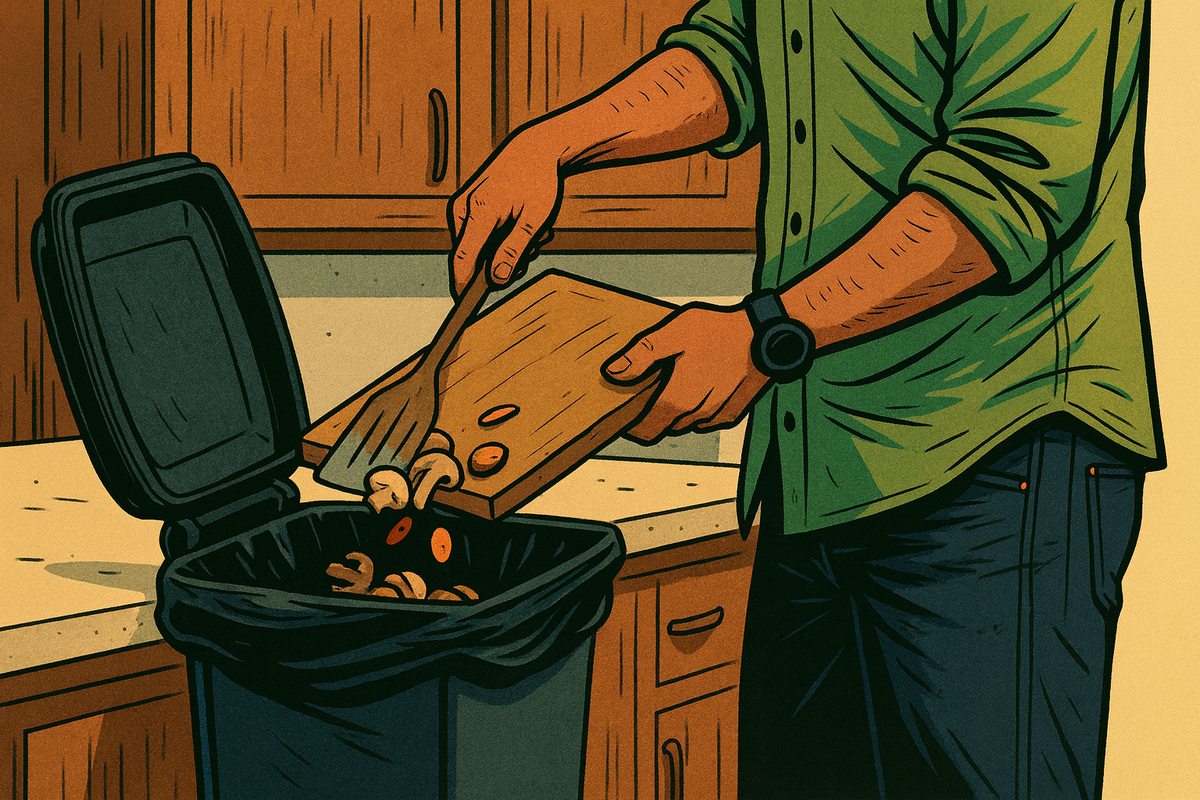
Composting does help with food waste — particularly peelings, cores, and scraps that are hard to avoid when you cook. Separating those out immediately reduced how full my bin got, which felt encouraging.
But composting didn’t stop food waste from happening. It just changed where some of it went.
What I noticed was that:
- composting dealt well with unavoidable scraps
- but it didn’t fix unused ingredients or forgotten leftovers
- it didn’t stop me buying more than I needed
It helped emotionally too — throwing food into compost felt better than throwing it in the bin — but it wasn’t a complete solution on its own.
I still compost, and I think it’s worth doing if you can. I just stopped expecting it to solve the bigger problem.
Cooking “Smaller” Meals (Easier Said Than Done)
Another thing I tried was simply cooking smaller portions.
This sounds obvious, but it turned out to be surprisingly awkward.
Recipes are rarely written for one person, and scaling them down isn’t always straightforward. Ingredients often come in fixed sizes, so even if I cooked less, I still had half a packet of something left over.
I also found that cooking very small meals sometimes felt inefficient. Using the oven or hob for one portion felt like a lot of effort, which made takeaway or convenience food more tempting later in the week.
Cooking smaller helped a bit — but it didn’t solve the issue of buying food in quantities that didn’t suit me in the first place.
Freezing: Useful, But Not Foolproof
Freezing is often suggested as the answer for people living alone, and I did lean into it for a while.
Some things froze well. Others didn’t. And some things froze well but still didn’t get eaten.
What I learned was:
- frozen food is easy to forget about
- having lots of frozen “backup meals” doesn’t always match how I want to eat
- defrosting requires planning, which I’m not always good at
Freezing works best for me as a supporting habit, not a main strategy. It helps occasionally, but it didn’t dramatically reduce my food waste on its own.
Buying Loose Food: A Good Idea That Gets Complicated
Buying loose food felt like the obvious answer.
In theory, it solves a lot of problems:
- you buy only what you need
- there’s less packaging
- portion sizes are flexible
I tried buying loose fruit and vegetables wherever possible, and I made an effort to shop at places with refill sections and loose dry goods like cereals, grains, and pasta.
What I ran into fairly quickly, though, was cost.
Loose and refill options are often:
- more expensive
- less convenient
- not always available locally
For someone living alone on a budget, this made it hard to rely on consistently. I found myself paying more for staples, which added pressure elsewhere.
Buying loose helped reduce waste, but it wasn’t financially sustainable for me as a main approach.
Farm Shops and Refill Stores: Nice, But Not Always Practical
I also tried farm shops and refill-style stores with containered dry goods.
These spaces are lovely. They encourage slower shopping and more thoughtful buying. And when I did shop there, I genuinely enjoyed the experience.
But again, there were trade-offs.
For me, they were:
- significantly more expensive
- not always easy to get to
- hard to use for everyday staples
I found myself treating them as an occasional option rather than a regular solution. They worked well for certain items or as a top-up, but I couldn’t realistically base all my food shopping around them.
That’s not a criticism of those shops — just an acknowledgement of my own limits.
Meal Planning (Again): Helpful in Theory, Fragile in Practice
I gave meal planning another go, this time with simpler expectations.
Instead of planning a full week, I planned:
- a few meals
- around ingredients I already had
- with flexibility built in
This helped a little, but it still relied on my energy levels staying consistent — which they didn’t always do.
If I had a busy or tiring week, plans slipped and food still went uneaten. Meal planning reduced waste sometimes, but not reliably enough to feel like the answer.
Why Simmer Eats Ended Up Working Best for Me
After trying all of the above, I ended up back at meal prep — and specifically Simmer Eats.
Not because it’s perfect. But because it solved the main issue I kept running into: portion sizes for one person.
What worked for me was:
- meals designed for one person
- no leftover ingredients
- no unused fresh produce
- predictable waste (one cardboard container per meal)
Instead of juggling half-used packets and forgotten leftovers, I had clear, defined meals that I actually ate.
That clarity reduced my food waste far more than trying to optimise everything else.
The Packaging Trade-Off (Again)
I’m very aware that meal prep involves packaging.
In my case, each meal creates one cardboard container, which goes into cardboard recycling. Compared to the mix of food waste, plastic packaging, and general waste I was producing before, this felt like a trade-off I could live with.
It’s not zero waste.
But it’s lower waste for me.
That distinction matters.
Why “Trying Harder” Wasn’t the Answer
Looking back, the biggest shift wasn’t any single tactic — it was letting go of the idea that effort alone would fix the problem.
Food waste when you live alone isn’t just about discipline or organisation. It’s about systems that aren’t designed with solo households in mind.
Once I stopped blaming myself and started adapting my approach, things improved.
What Living Alone Has Changed About How I Think About Food
Living alone has made me more honest about:
- how much variety I actually need
- how often I realistically cook
- how quickly food goes off when it’s just me
It’s also made me more accepting of imperfect solutions. Something doesn’t have to be ideal to be better than what came before.
What I’d Say to Someone Else Living Alone
If you’re living alone and struggling with food waste, this is what I’d gently suggest:
- try things, but don’t force them
- pay attention to what actually gets eaten
- don’t assume the most “eco” option is the best fit
- accept trade-offs that reduce waste overall
Your solution might look different to mine — and that’s okay.
A Final Thought
Food waste when you live alone is harder than it looks, and it’s not because you’re doing something wrong.
I tried composting, freezing, meal planning, buying loose, farm shops, refill stores — and all of them helped a bit. But none of them worked as well for me as having meals portioned for one that I actually ate.
That doesn’t make meal prep perfect.
It just makes it practical.
I still adjust. I still experiment. I’m still figuring it out.
But I waste less food than I used to — and for now, that feels like the right direction.